From Birmingham News Room
"Staff at Birmingham City Council making preparations for their move to the Library of Birmingham building in 2013 have uncovered what could be the UK’s largest collection of silent movie scores, including a unique Charlie Chaplin theme tune."

Showing posts with label local history. Show all posts
Showing posts with label local history. Show all posts
Wednesday, July 20, 2011

Tuesday, June 7, 2011
10 more fascinating facts about Erdington
- Mothers was a famous rock club that ran from 1968 until 1971, it located on Erdington High Street opposite St Barnabas church. Pink Floyd recorded part of their Ummagumma live album there. Other bands that played there included Black Sabbath, The Who and Free. Not a bad line-up!
- Rookery House in Rookery Park was originally called Birches Green however it was renamed in the early 20th century because it was bought by someone who owned another house just down Kingsbury Road also called Birches Green.
- In 1960 a Mr T.Haywood, who was a lorry driver from Erdington, became the first person to walk from Edinburgh to London in less than 7 days when he beat the time set by Dr Barbara Moore.
- In 1880 the landlords of the Roebuck and the Red Lion pubs were questioned by the police for allegedly allowing illegal gambling on their premises.
- Erdington Safeway was one of a number of the firm's stores which were targetted by an extortioner who deliberately contaminated jars of food in 1981. A ransom demand was sent to the company's headquarters for £500,000. Jars of gherkins at the Erdington store were found contaminated with paraquat.
- The orphanage set up by Josiah Mason cost £60,000 back in 1870 and was given an endowment valued at £200,000
- A notable horse race in the 1870s, often mentioned in the same breath as the Grand National, was the Erdington Plate. The race was often held at Sutton Coldfield race track.
- The Bagot Arms pub is named after the Bagot family who owned Pype Hayes Hall during the 19th century. The house was sold to the wire making industrialist James Rollason in 1906, who now has a road named after him in Erdington.
- In the early part of the 20th century Erdington had an ice rink which was on the site of the current fire station.
- Spring Lane Primary School was the new site of the school that was once on the High Street but moved after WW2, during the war the Spring Lane site was a barracks and armoury.
Thursday, May 26, 2011
Photo : Shakespeare's tomb
The Bard's tomb in the Church of the Holy Trinity, Stratford-upon-Avon.
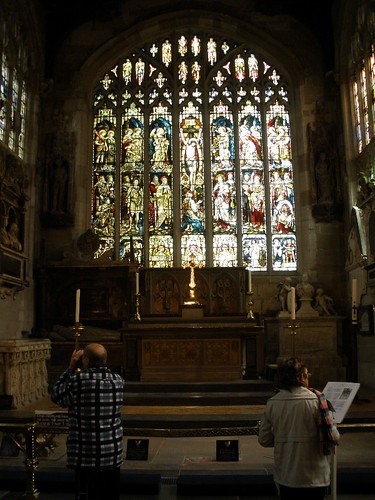
I took a number of photographs in historic Stratford-upon-Avon yesterday, you can see them all here.
I took a number of photographs in historic Stratford-upon-Avon yesterday, you can see them all here.
10 fascinating facts about Erdington
I am thinking about doing a Erdington history blog, while i decide here is a little list of 10 fascinating facts about this village i live in.
- Chester Road probably predates the Romans and as you can thus imagine is one of the oldest roads in the area. Between Kenilworth and Brownhills the road follows the route of the ancient Welsh Road.
- The Dwarf Holes were mysterious artificial caves, which were lost due to the construction of the Gravelly Hill Interchange. They may have dated from the Stone Age. They were mentioned in deeds dating from the 15th century in any case.
- The brick factory on Holly Lane supplied the bricks for many of Erdington's houses up until WW2. Twenty million bricks were used to build Fort Dunlop.
- Fort Dunlop was at one time the largest tyre factory in the British Commonwealth, it was built where it was because of the ready supply of water from the River Tame and surrounding fields.
- The murder of Mary Ashford in Erdington in 1817 and the resulting trial ended up with the British legal system being changed after the defendant Abraham Thornton challenged his accuser (Mary's younger brother) to a duel who, as he was just a young lad, declined thus forcing the case to be dismissed. News of this case travelled far and wide, when Thornton tried to emigrate to the US he had a lot of trouble trying to get a ship in Liverpool as the fellow passengers did not want to share the same boat as a "murderer".
- Number 2 Fern Road was the last house with a thatched roof in Birmingham though it's roof was replaced in 1944 due to the fire risk.
- Six Ways is reputed to be the oldest traffic roundabout in the UK.
- In the 1900s Birmingham Council planned to build a gas works on the Glenthorne estate, luckily they built the Birches Green housing estate instead.
- The Acorn Hotel was located on the High Street on the junction of Church Road up until the Second World War, a pub called The Acorn occupies part of the same site.
- Two companies bid for the railway line from Birmingham to Sutton Coldfield, the winning company building what is now the Cross City Line. The alternative plan envisaged a rail route to Erdington that would have gone along the Tyburn Road and Wood End Lane with stations on Mason Road and Orphanage Road.
Bibliography
Arkinstall M & Baird P (1976), 'Erdington Past & Present', Birmingham Public Libraries
Baxter M & Drake P (1995), 'Erdington', Tempus
Baxter M & Drake P (2003), 'Erdington Vol 2', Tempus
Maxam A (2008), 'Vintage Images of Erdington Birmingham', Adlard
Arkinstall M & Baird P (1976), 'Erdington Past & Present', Birmingham Public Libraries
Baxter M & Drake P (1995), 'Erdington', Tempus
Baxter M & Drake P (2003), 'Erdington Vol 2', Tempus
Maxam A (2008), 'Vintage Images of Erdington Birmingham', Adlard
Friday, December 3, 2010
Staffordshire Hoard wanted by museums around the world
From the Birmingham Post
"The Staffordshire Hoard could be taken on a world tour after dozens of museums said they would like to host the Anglo-Saxon treasure."
"The Staffordshire Hoard could be taken on a world tour after dozens of museums said they would like to host the Anglo-Saxon treasure."
Sunday, November 28, 2010
Birmingham Airport's old Maglev carriage sold on eBay
From the BBC
"A carriage from a magnetic shuttle used to transport airport passengers to a nearby railway station has been auctioned off for charity.
Birmingham Airport used Maglev carriages between 1984 and 1995. They were then replaced by cable cars."
"A carriage from a magnetic shuttle used to transport airport passengers to a nearby railway station has been auctioned off for charity.
Birmingham Airport used Maglev carriages between 1984 and 1995. They were then replaced by cable cars."
Friday, September 10, 2010
Tolkien relation sculpts Cardinal Newman statue
From the BBC
"The great-nephew of author JRR Tolkien has made a statue of Cardinal John Henry Newman for the Pope's visit to Birmingham.
Artist Tim Tolkien said Pope Benedict XVI would bless the statue when he performs the cardinal's beatification in Cofton Park on 19 September."
"The great-nephew of author JRR Tolkien has made a statue of Cardinal John Henry Newman for the Pope's visit to Birmingham.
Artist Tim Tolkien said Pope Benedict XVI would bless the statue when he performs the cardinal's beatification in Cofton Park on 19 September."
Thursday, September 9, 2010
125 years of Margaret Street
Something history related from the University i work at (and created the website for).
"This year the University celebrates a very special milestone - 125 years of art at Margaret Street
The School of Art building, more widely known as ‘Margaret Street’, opened in 1885 and has been providing opportunities for students to study art and design ever since."
I have also put a few videos onto Youtube by staff recounting their memories of being at Margaret Street, you can see one below or check out the others on the uni's Youtube channel.
"This year the University celebrates a very special milestone - 125 years of art at Margaret Street
The School of Art building, more widely known as ‘Margaret Street’, opened in 1885 and has been providing opportunities for students to study art and design ever since."
I have also put a few videos onto Youtube by staff recounting their memories of being at Margaret Street, you can see one below or check out the others on the uni's Youtube channel.
Wednesday, June 23, 2010
Photography exhibition reveals life on the canals in the 1940s and 50s
"Robert Longden's evocative pictures of working life on Britain's inland waterways of the 1940s and 50s are being shown for the first time.
It seems fitting that the Herbert Art Gallery in Coventry should be hosting an exhibition of Robert Longden's evocative pictures of working life on the inland waterways of the 1940s and 50s. Longden's employer was Sir Alfred Herbert, a local philanthropist who ran the biggest machine-tool company in the world from a factory that backed on to the Coventry canal. Both men died in 1957. Herbert bequeathed the gallery to the city and Longden's photographs are about to be shown there for the first time..."

It seems fitting that the Herbert Art Gallery in Coventry should be hosting an exhibition of Robert Longden's evocative pictures of working life on the inland waterways of the 1940s and 50s. Longden's employer was Sir Alfred Herbert, a local philanthropist who ran the biggest machine-tool company in the world from a factory that backed on to the Coventry canal. Both men died in 1957. Herbert bequeathed the gallery to the city and Longden's photographs are about to be shown there for the first time..."

Friday, April 2, 2010
30 odd years of changes... or not as the case may be
Whilst looking through some old photographs i found one of the first house i ever lived in in the early 1970s (though i was too young at the time to remember anything about it!) Thanks to Google Street View i was able to have a look and see what the house looks like today and to be honest there have not been a great deal of changes over the last 35 or so years.

Apart from the doors, windows and maybe the odd bit of paint the house itself is not that different though the garden has changed dramatically.


Apart from the doors, windows and maybe the odd bit of paint the house itself is not that different though the garden has changed dramatically.

Wednesday, March 24, 2010
Anglo Saxon Hoard saved
Birmingham Museum and Art Gallery and the Potteries Museum and Art Gallery, Stoke on Trent are celebrating today following the announcement that the £3.3 million to acquire the Staffordshire Hoard has been secured a month ahead of schedule – but the fundraising continues.
The announcement comes after news that the National Heritage Memorial Fund (NHMF) has approved a donation of £1.285 million that will meet the initial target of £3.3 million needed to acquire the joint ownership of the Hoard by Birmingham and Stoke museums...

The announcement comes after news that the National Heritage Memorial Fund (NHMF) has approved a donation of £1.285 million that will meet the initial target of £3.3 million needed to acquire the joint ownership of the Hoard by Birmingham and Stoke museums...

Friday, November 20, 2009
Birmingham museum receives £4.8 million funding for history project
Birmingham Museum and Gallery has been granted £4.8 million to create a new wing dedicated to the history of Birmingham.
The museum, which also hopes to be home to the Staffordshire Hoard, was awarded the grant from the Heritage Lottery Fund (HLF).
The money will be used to boost the £9.7million project Birmingham – A City in the Making project, which includes the development of a new wing of galleries focussing on the history and development of Birmingham and its people...
The museum, which also hopes to be home to the Staffordshire Hoard, was awarded the grant from the Heritage Lottery Fund (HLF).
The money will be used to boost the £9.7million project Birmingham – A City in the Making project, which includes the development of a new wing of galleries focussing on the history and development of Birmingham and its people...
Tuesday, November 10, 2009
This treasure stirs the West Midlands' Anglo-Saxon soul
"The Staffordshire hoard has brought history to life in modern-day Mercia – and it is here that the collection has to return."
From the Lindisfarne gospels to the Lewis chessmen, much of British heritage policy is about putting things back where they belong. Now we have a golden opportunity not to commit the original sin, and ensure the most fascinating find in a generation remains where it should...
From the Lindisfarne gospels to the Lewis chessmen, much of British heritage policy is about putting things back where they belong. Now we have a golden opportunity not to commit the original sin, and ensure the most fascinating find in a generation remains where it should...
Saturday, September 12, 2009
Tuesday, July 21, 2009
Coast returns
Slightly late i know as the first part of the new series was shown on the 11th of July but Coast has returned to BBC2. It is a very good series which is well worth watching, for those who haven't seen it before, following along a portion of the British coastline and reporting on interesting aspects of local history (as well as some geography and nature). The first part included a feature on the Red Sands Sea Forts, an electric railway that ran along the sea shore (and hence underwater) and early film making in Brighton.
Sunday, October 19, 2008
D9 50th Anniversary
History is not just walking around museums or trawling through dusty archives, history also includes the preservation of the once commonplace and mundane. Old buses are an interest of mine though mainly from the late 1960s to the late 1980s. One of my favourite places to visit in this vein is the Aston Manor Transport Museum which held an open day today to celebrate the 50th anniversary of the BMMO D9 bus.

So the theme of the day was Midland Red, personally i grew up in WMPTE territory so my Midland Red experience is not that wide, i remember taking the X99 a few times to Sutton Coldfield. That doesn't matter, it was great to see a wide selection of Midland Red and other operators' buses including at least 3 Routemasters. I travelled on one of these and later a D9 on some trips to the city centre and back. The great thing about this kind of history is that you can interact with it, relive it. You can't really do that with a Roman sword, well not legally anyway.
The full set of pictures are here. For more information about the D9 this webpage has a brief history.

So the theme of the day was Midland Red, personally i grew up in WMPTE territory so my Midland Red experience is not that wide, i remember taking the X99 a few times to Sutton Coldfield. That doesn't matter, it was great to see a wide selection of Midland Red and other operators' buses including at least 3 Routemasters. I travelled on one of these and later a D9 on some trips to the city centre and back. The great thing about this kind of history is that you can interact with it, relive it. You can't really do that with a Roman sword, well not legally anyway.
The full set of pictures are here. For more information about the D9 this webpage has a brief history.
Friday, October 10, 2008
Long Acre photographs
These two photographs were taken by my Grandfather a long time ago. Unfortunately they are undated and unlabelled but are likely to be of Long Acre, Aston in the early 1960s or late 1950s. In the second photo you can see the power station that Star City was built upon. Its a very different area now of course, few if any of the buildings seen here still exist and of course the M6, A38(M) and Gravelly Hill Interchange are yet to come.


Monday, September 15, 2008
Old Birmingham in photographs
A couple of photos from my collection of "old" Birmingham. Though not that old really, no older than the 1970s or 1980s (but of course to any teenager this means ancient history). As a fan of Brutalist architecture I prefer the old Bull Ring to the swish modern one, though i have to admit the shops in the new one are better!


Subscribe to:
Posts (Atom)